Mattress guidance
Soft, Medium or Extra-Firm? Understanding Vispring’s Tension Options
A mattress label can suggest how a spring unit is configured, but it cannot predict exactly how a bed will feel beneath every body. Sleep position, pressure points, upholstery and the person sharing the mattress all shape the experience. Understanding these factors makes the choice between soft, medium, firm and extra-firm a more practical one.
When a sleeper settles onto a mattress, the result is a small negotiation between body and materials. The shoulders and hips press down; the waist and legs distribute weight differently; springs respond beneath layers of wool, cotton or other upholstery. The word printed beside a tension option captures only one part of that exchange.
Vispring describes its spring tensions as Soft, Medium, Firm and Extra Firm. These terms refer to the spring system’s tension, not to a universal comfort scale shared by every mattress maker. Nor do they tell the whole story of the surface. Two models set to the same tension can feel distinct because their fillings, construction and depth differ. A useful decision therefore begins not with a label, but with a closer look at how you sleep and what your body needs from a mattress.
This guide explains what tension means, how sleep position and pressure can help you assess it, and why a partner’s preferences matter. It is general guidance, not a medical assessment: persistent pain, numbness or other concerning symptoms are worth discussing with a qualified health professional.
What mattress tension describes
In a pocket-sprung mattress, each coil is held in an individual fabric pocket. When weight presses down, the springs compress and push back. Tension describes the resistance of that spring system to compression. In broad terms, a softer tension yields more readily, while a firmer tension resists more strongly. The degree of support and the subjective feeling of comfort, however, are related but not identical.
Think of the spring unit as the responsive structure underneath the surface rather than the entire sleeping experience. The upholstery above it adds cushioning, changes how quickly the mattress responds and influences the sensation at first contact. Natural fillings such as wool and cotton, and materials such as horsetail in some models, can give the surface a different character. Tufting and the way layers are arranged also contribute to how the mattress settles under the sleeper.
That is why “firm” does not automatically mean supportive and “soft” does not automatically mean unsupportive. Support concerns how the body is held across the sleeping surface; softness is one description of how readily the surface gives way. A mattress that feels pleasant in the first few minutes may not suit someone’s pressure needs through a full night, while a surface that feels unfamiliar at first may prove more comfortable after a proper trial.
Spring count alone is not a reliable shortcut to comfort either. It is one construction detail among several, and counts can depend on mattress size and how they are reported. A higher number does not, by itself, establish that a mattress is more suitable for a particular sleeper. Tension, spring design, upholstery and fit to the individual all deserve consideration.
How the four tension options may feel
The descriptions below are starting points, not guarantees. Individual perception varies, and the same person may experience a mattress differently depending on body shape, sleeping position, bedding and the model’s upholstery.
- Soft: The spring unit yields more readily under load. Some sleepers enjoy the closer, more accommodating feel, particularly if they want the shoulders and hips to settle into the surface. The key question is whether the body still feels comfortably supported rather than excessively dipped or constrained.
- Medium: A middle option that may suit people who do not want a strongly yielding or strongly resistant feel. It is not a guaranteed compromise for every body or sleeping style, but it can be a useful place to begin comparisons.
- Firm: The spring unit resists compression more than a softer option. Some sleepers prefer the more solid response, especially if they dislike a feeling of sinking. Whether that response is comfortable depends on pressure distribution and the mattress as a whole.
- Extra Firm: The most resistant option in this set. It may appeal to people who specifically prefer a very firm-feeling spring system, but choosing it simply because it sounds “better for your back” is not a reliable rule.
These labels are comparative within the maker’s range; they are not a standardised measurement that allows a perfect comparison between brands. A “medium” in one collection may not feel the same as a “medium” elsewhere. Even within one range, changes in fillings and construction can alter the surface sensation.
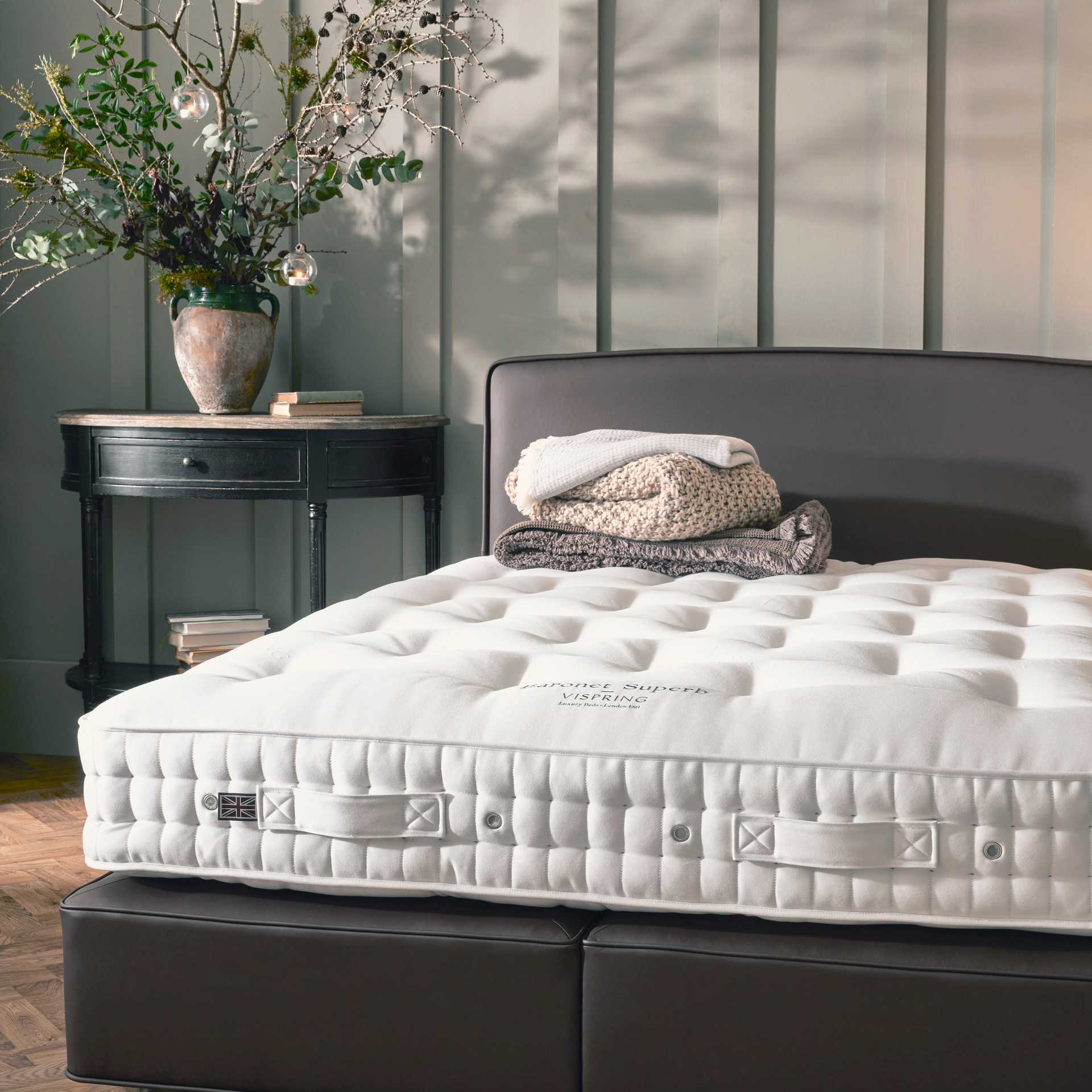
For a sense of how construction can vary, the Vispring Baronet Superb Mattress is described with a single row of hand-nested calico pocket springs and natural fillings including British fleece wool, cotton and horsehair. The Vispring Regal Superb Mattress also offers the four stated tension choices, while its listed fillings include wool, cotton and South American horsetail. These examples illustrate why tension should be considered alongside the model’s upholstery rather than treated as a complete comfort description.
Begin with your usual sleep position
Sleep position can help identify where pressure is likely to gather, though it cannot determine the right tension on its own. Many people change position during the night, and some have no single habitual posture. Start with the position in which you spend the most time, then consider whether you wake with pressure or discomfort.
Side sleeping
On your side, the shoulders and hips often meet the mattress first. If the surface does not yield enough for those areas to settle, pressure may become noticeable. A more accommodating feel can be appealing to some side sleepers, but the goal is not to sink without limit. Look for a comfortable balance: enough give at the prominent joints, with the rest of the body feeling supported rather than hanging in a hollow.
Back sleeping
Back sleepers distribute contact across a broader area, but the shape of the lower back and the position of the hips still influence how a mattress feels. Notice whether the surface feels evenly supportive, or whether the hips seem to drop markedly compared with the torso. A mattress that feels too resistant may also create uncomfortable pressure for some people. Your own response matters more than a generalised rule about which tension back sleepers “should” choose.
Front sleeping
People who sleep on their front may be especially aware of how the middle of the body settles. If the pelvis sinks more than feels comfortable, the resulting posture may seem strained. A more resistant spring system might feel preferable to some stomach sleepers, but a firm label alone cannot confirm that the mattress will suit them. Test the whole surface and pay attention to comfort in the position you actually use.
Combination sleeping
If you turn between positions, consider how easy it feels to move and settle again. A surface that is deeply yielding may feel restful in one position yet make repositioning less comfortable for another sleeper. Conversely, a very resistant feel may be easy to move across but too unyielding at the shoulders or hips. There is no single ideal for every combination sleeper; trialling the likely options is especially useful.
Use pressure and alignment as clues
Instead of asking only, “Is this soft or firm?”, ask what your body is telling you. While lying in your ordinary sleep position, notice your shoulders, hips, waist and lower back. Do you feel a distinct pressure point? Does any area seem to sink much farther than the rest? Can you relax without repeatedly adjusting your position?
These observations are not a diagnostic test, and a short showroom visit cannot reproduce an entire night’s sleep. They can, however, help you compare options thoughtfully. Try to spend enough time on each mattress for your body to settle. Lie in the positions you use at home, and avoid judging solely from sitting on the edge or pressing a hand into the surface.
It may help to compare one tension at a time while keeping the rest of the conditions as similar as possible. Use your own pillow if practical, since pillow height can change how your neck and shoulders feel. If the mattress is on a particular base, check that the base is appropriate and compatible: the foundation beneath a mattress can affect its performance and sensation.
At home, keep brief notes after each night if you are assessing a new mattress during a trial period. Record your usual position, whether you woke with pressure or stiffness, and whether the feeling eased after getting up. One uncomfortable night is not necessarily decisive, but a repeated pattern can be informative. Follow the seller’s current trial, care and return terms, and give yourself enough time to make an informed judgement where a trial is available.
Body weight, shape and personal preference
Body weight affects how much a spring unit compresses, but weight alone cannot prescribe a tension. Body shape and the way weight is distributed also matter. Two people of similar weight may experience a mattress differently because their shoulders, hips and waist meet the surface in different ways. Mobility, sensitivity to pressure and a lifetime of sleeping preferences add further variation.
Some lighter sleepers may find that a more resistant spring system gives less noticeable contouring; some heavier sleepers may prefer a firmer response. These are possible tendencies, not rules. A model’s upholstery can soften the first impression, and the spring system may still provide a different level of resistance beneath that comfort layer. The practical test is whether the mattress feels comfortable and supportive to you over time.
Personal preference is not a trivial factor. If you have slept well for years on a particular kind of surface, that experience is relevant, even if it does not map neatly onto a tension label. At the same time, familiarity should not be mistaken for proof that a particular choice is right. Compare options with an open mind, and be alert to discomfort rather than trying to persuade yourself that a mattress must feel good because its specifications sound impressive.
When two people share a mattress
For couples, the choice becomes a shared landscape. One person may favour a yielding surface while the other wants a firmer response. Differences in body weight, sleep position, temperature comfort and sensitivity to movement can make a single tension feel like a compromise for both.
Vispring lists split firmness for King-size options on the models described here. A split-tension arrangement allows each side to be specified differently, subject to the particular model and available configuration. It can be worth asking a retailer to confirm exactly how the split is constructed, which sizes qualify and whether the finished bed meets both sleepers’ needs. Do not assume that all mattresses, sizes or bases offer identical arrangements.
Before choosing, each partner should test the side they expect to sleep on. Then lie together if possible. Consider whether movement across the bed disturbs either person, whether the centre feels comfortable and whether the division between tensions is noticeable. Pocket springs are individually housed, a design intended to allow localised response, but a mattress’s overall motion behaviour depends on its full construction and the sleepers themselves.
If a split is not available or does not feel right, the couple can compare a shared middle-ground tension, separate single mattresses within one bed arrangement, or another suitable configuration. The right solution depends on the bed frame, room, budget and practical preferences. The important point is to discuss comfort as two related but distinct experiences rather than assuming both bodies will respond alike.
Why the fillings matter as much as the springs
Spring tension describes the resistance of the spring unit; upholstery shapes what happens between that structure and the sleeper. Natural materials commonly used in premium mattresses can differ in resilience, loft and feel. Wool and cotton are among the fillings listed across Vispring models, while some models also use horsehair or horsetail. Their placement and quantity vary, so a material name alone does not tell you precisely how a mattress will feel.
Layers may compress and respond differently from the springs beneath them. A generous comfort layer can make first contact feel more cushioned, while the coil system still contributes its own resistance as the sleeper settles. Hand-tufting is used to secure filling layers in position. Mattress depth, cover fabric and border construction are additional details, but none should be mistaken for a direct measure of comfort or suitability.
This is why it is useful to compare the exact model and tension together. A shopper comparing two mattresses should ask not only which spring tension is specified, but also what fillings sit above it, how the layers are arranged and how the surface feels in their ordinary sleep position. Product descriptions explain construction; personal testing helps translate that construction into an individual experience.
Common assumptions to reconsider
- “The firmest mattress is best for everyone.” There is no universal tension that suits every sleeper. Comfort and support depend on the person and the complete mattress.
- “A softer mattress cannot support the body.” A softer spring tension is not automatically unsupportive. The question is how the body settles and whether the surface remains comfortable.
- “Medium means the same thing across brands.” Labels are not a universal scale. Comparisons are most meaningful within a specific range, and even then upholstery can change the feel.
- “My sleeping position decides the answer.” Position is helpful context, not a prescription. Pressure, body shape and personal preference matter too.
- “A high spring count guarantees a better mattress.” Spring count is only one specification. It does not independently establish comfort, durability or suitability.
- “One quick test is enough.” A brief lie-down can reveal an immediate dislike, but it cannot fully predict a night’s sleep. Use a trial period where available and follow its terms.
A practical checklist before choosing
Use this checklist to organise a comparison, whether you are testing mattresses in person or reviewing a model’s specifications. It cannot replace a proper trial, but it can prevent the tension label from dominating the decision.
- Identify the sleep position you use most, and note any positions you switch into during the night.
- Think about where you most often feel pressure when lying down, especially at the shoulders, hips or waist.
- Try the mattress in a relaxed posture rather than judging by touch or appearance alone.
- Compare the spring tension with the model’s fillings, upholstery and depth.
- Check that the bed base is compatible and in suitable condition.
- If you share the bed, have both sleepers test it and discuss preferences separately.
- Ask whether split tension is available for the exact model and size under consideration.
- Read the written terms for any home trial, including its duration, care requirements and return conditions.
- Keep track of repeated comfort patterns rather than relying on a single night or a single impression.
A better question than “Which tension is best?”
Soft, Medium, Firm and Extra Firm are useful distinctions when they are understood as choices about spring resistance. They are not promises of a particular feeling, and they do not rank mattresses from poor to good. The upholstery above the coils changes the surface; sleep position and body shape influence pressure; and a partner may experience the same bed differently.
Rather than searching for the universally correct label, ask which combination of spring tension and mattress construction allows you to rest comfortably in your usual position. Pay attention to your shoulders and hips, notice whether your body feels evenly settled, and compare the actual models rather than relying on category names alone. If two sleepers have different preferences, ask about the available split-tension configuration and assess each side as carefully as the other.
A mattress is not a medical treatment, and no tension label can guarantee pain relief or perfect sleep. It is one element in a broader sleep environment that includes routine, light, noise, temperature and health. But a careful, informed choice can help make the bed a more comfortable place to begin and end the day.