Sleep science · Mattress construction
What Spring Counts Can—and Can’t—Tell You About a Mattress
A spring count looks like a neat answer to a complicated question: how well will this mattress support you? The number can offer clues, but only when you know what it counts, which size it describes and how the springs work with the layers around them.
Lift the corner of a mattress and its hidden architecture begins to emerge: a framework of coils, pockets, padding and fabric, built to carry a sleeper through thousands of nights. Among the figures used to describe that structure, spring count is one of the most conspicuous. It seems to invite a simple contest: more springs must mean more support.
That conclusion is tempting—and incomplete. A count is not a universal measure of comfort, durability or spinal support. Two figures may describe different mattress sizes, different spring layers, or even different ways of counting. Even when the basis is the same, the number does not reveal a spring’s tension, shape, arrangement or interaction with the upholstery above it.
To read a mattress specification well, treat its spring count as a starting point rather than a verdict. Ask what the figure refers to, then consider the complete construction and how it suits the people who will sleep on it.
First question: what exactly is being counted?
In a pocket-spring mattress, each coil is enclosed in its own fabric pocket. The pockets sit beside one another in a spring unit, allowing individual coils to respond to pressure in their immediate area. A manufacturer may state how many springs are used in a particular mattress size, but the count is meaningful only alongside that size and the construction details.
A figure for a king-size mattress cannot be compared fairly with one for a smaller model as if both cover the same area. A larger surface will generally accommodate more springs. The more useful question is whether the two figures describe comparable sizes, and whether the manufacturers use the same basis for reporting them.
There can be another complication: a mattress may contain more than one spring layer. A specification might list the total number of springs across two layers, while another might give the count for one layer or describe a single-tier system. A larger total, by itself, does not tell you how those springs are distributed, how each layer is configured or what the arrangement feels like.
Look for clear language that identifies the mattress size, the number of spring layers and the count within each layer. If a figure is presented without context, it is reasonable to ask for clarification. The point is not to distrust the number, but to understand what it measures before using it to compare mattresses.
Pocket springs: independence is part of the story
With pocket springs, the fabric around each coil helps it move more independently than springs that are rigidly connected across a unit. When someone lies down, the springs beneath the body compress in response to that local load. Nearby coils may respond too, but the pocketed construction is intended to limit the direct transfer of movement from one spring to the next.
This can matter to couples, particularly when one sleeper changes position. Yet a spring count cannot, on its own, tell you how much movement will be felt on the other side of the bed. The pocket material, spring arrangement, upholstery, mattress base and the sleepers themselves all influence the experience. Motion isolation is a quality of the whole construction, not a number printed in isolation.
The way springs are arranged matters as well. Some pocketed systems use a close, orderly layout; others may use a different pattern or combine springs in layers. The count tells you how many are reported, not their exact spacing, their behaviour under a particular load or whether the mattress will feel suitable to your body.
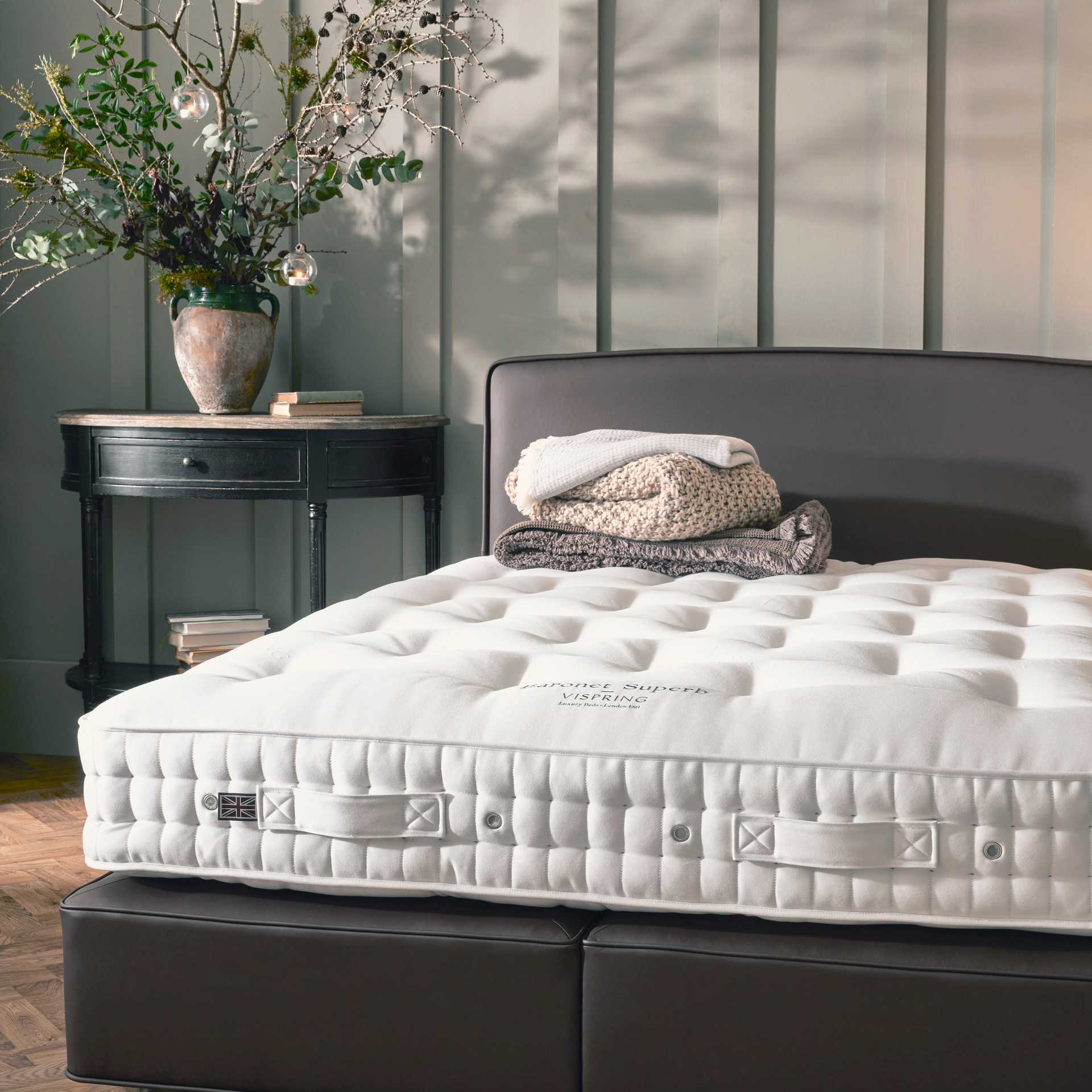
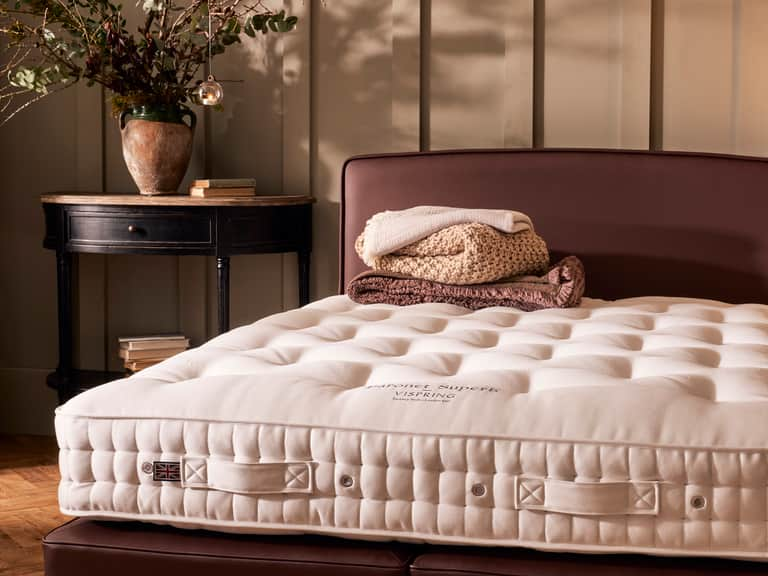
For example, the Vispring Baronet Superb Mattress is described as having a single row of hand-nested calico pocket springs, with 1,716 springs in a king size. That detail is more informative when read alongside its stated spring tensions—Soft, Medium, Firm and Extra Firm—and its natural-fibre upholstery. It still cannot predict precisely how any one person will experience the mattress.
A spring count is not a firmness rating
Firmness is a sensation as well as a construction choice. It depends on how much a mattress yields under a sleeper, how quickly it responds, and how its layers distribute pressure. The spring count alone cannot tell you whether the surface will feel soft, medium or firm.
Spring tension is one important part of that picture. A coil’s resistance to compression affects how it responds as weight is applied. Two mattresses could have similar counts but use springs with different tensions, dimensions or arrangements. Their feel may therefore differ substantially. Conversely, a mattress with a lower count is not automatically softer, less supportive or inferior.
Firmness labels are useful as a guide, but they are not a perfectly standardised scale shared by every manufacturer. A “firm” option from one maker may not feel identical to a “firm” option from another. Sleep position, body shape, personal preference and the amount of cushioning above the springs all influence perception. Whenever possible, use a trial period or test the mattress in a way that reflects how you actually sleep.
For partners with different preferences, split firmness can be worth investigating. Some king-size mattresses allow different tensions on each side, so both sleepers can choose a support feel that suits them without relying on a single compromise setting. That option is a design feature, not something that can be inferred from a total spring count.
What the fillings contribute
Springs form the supporting structure, but they are only one part of the mattress. Above them, upholstery layers shape the initial feel, cushion pressure points and influence how the surface responds as a sleeper moves. Natural fillings such as wool, cotton and horsehair have different textures and properties; their quantity, placement and preparation can all affect the result.
Wool can absorb and release moisture, while the spring unit and surrounding materials contribute to the way air moves through the mattress. Cotton can add a softer or more even layer, depending on how it is used. Horsehair, with its naturally springy fibres, is sometimes included for resilience and loft. These general material characteristics do not guarantee a specific sleep outcome, and the final feel depends on the complete design.
Hand tufting, where tufts pass through the mattress to secure the upholstery layers, can help keep fillings in position. Side-stitching reinforces the border in some constructions. Neither feature is expressed by the spring count, yet both can influence how the mattress is assembled and how its surface is held together. A rounded specification therefore needs to describe the layers and finishing as well as the coils.
Consider the Vispring Regal Superb Mattress as one example of a more complete description: its stated king-size count is 2,236 springs in a single row, while its upholstery includes wool, cotton and South American horsetail. Its listed spring tensions range from Soft to Extra Firm. Those details offer a broader picture than the count alone, though personal comfort remains a matter of fit and preference.
Why “more springs” does not automatically mean “more support”
Support is not a contest in which each additional coil adds a predictable unit of comfort. A high count may reflect a particular spring size or layout, and a mattress with many small springs may behave differently from one with fewer, larger coils. Without details about the spring design and the mattress as a whole, the total is difficult to interpret.
Support also involves how the mattress accommodates the body. A comfortable surface should allow the sleeper to settle without feeling that one area is bearing an uncomfortable concentration of pressure. Whether it achieves that for a particular person depends on factors including body shape, sleeping position, tension, upholstery depth and the support beneath the mattress.
It is equally unwise to treat a high spring count as proof of longer life. Durability depends on material quality, design, workmanship, use and care. A count does not reveal how a spring will perform after repeated compression, nor does it show whether the surrounding upholstery will retain its shape. Construction details and the maker’s care and warranty information are more useful evidence than a headline number alone.
Nor does a lower count necessarily signal a poor mattress. If its springs are appropriately designed and combined with suitable upholstery, it may provide a comfortable and supportive surface for its intended user. A comparison based on count alone can obscure the very differences that matter most.
A practical way to compare mattresses
When reading specifications, move from the headline figure to the underlying questions. This approach makes it easier to compare like with like and to focus on the qualities you can evaluate.
- Check the mattress size. Confirm that the counts refer to the same size, or find the figures for equivalent sizes before comparing.
- Identify what the total includes. Ask whether the number describes one spring layer or several, and whether the manufacturer explains the counting method.
- Look at the spring type and construction. Determine whether the mattress uses pocket springs and whether the description explains how they are arranged or nested.
- Read the tension options. Soft, Medium, Firm and Extra Firm describe a choice of spring resistance, though labels are not a universal cross-brand scale.
- Examine the upholstery. Find out what materials sit above the spring unit, how many layers are described and how they are secured.
- Consider the border and edge. Side construction can influence how the mattress behaves near its perimeter and how much of the surface feels usable.
- Match the design to the sleeper. Think about preferred sleeping position, comfort needs, partner movement and whether split firmness is available.
- Try before deciding, if possible. A specification can narrow the choices; a careful trial helps reveal whether the feel suits you.
These questions also help make retailer conversations more precise. Instead of asking only, “How many springs does it have?” ask, “What size does that count apply to? Does it include every layer? What tension options are available, and what fillings sit above the springs?” Answers to those questions describe a mattress more clearly than an isolated total.
The support system beneath the mattress matters, too
A mattress does not perform in a vacuum. The base beneath it can affect how evenly it is supported, and a base that is damaged, uneven or incompatible may alter the feel of even a carefully made spring unit. Follow the manufacturer’s guidance on suitable bases and care, including any advice about turning or rotating the mattress.
Room conditions also shape comfort. Bedding, room temperature and ventilation can affect the sleeping environment, while the mattress’s own materials influence how it manages moisture and heat. A large spring count cannot tell you whether the bedroom is too warm, whether bedding is trapping heat or whether another aspect of the sleep setting needs attention.
If discomfort persists, changing mattresses may not be the only consideration. Sleep environment, habits and health can all play a role. A mattress comparison is not a medical assessment, and no spring specification should be treated as a guarantee of pain relief or a remedy for a health condition.
Common spring-count myths
“The highest count is always best.”
Not necessarily. Counts may refer to different sizes or layers, and a greater total does not establish that the tension, upholstery or feel is right for you.
“More springs mean a firmer mattress.”
Firmness is influenced by spring tension and the materials above the springs, among other factors. A count does not function as a firmness scale.
“A large count proves better quality.”
Quality is a broader question involving materials, design, construction and durability. A number cannot certify workmanship or long-term performance.
“Pocket springs prevent all partner disturbance.”
Individually pocketed springs can respond more locally than interconnected coils, but the complete mattress and the movements of its sleepers affect how much motion is felt.
The useful number is the one you can interpret
Spring counts have a place in mattress research. They can help describe a construction, and they may be useful when two mattresses are specified on the same basis. But a count without context is like a map with no scale: it contains information, yet does not tell you how to navigate.
Start by checking the size and the spring layers. Then look at the type of spring, the available tensions, the fillings and the way the mattress is finished. Consider the sleeper’s preferences and the base beneath the bed. The number becomes more useful when it is one part of that wider account.
In the end, comfort is not arithmetic. A well-chosen mattress is not necessarily the one with the most coils, but the one whose construction and feel suit the person sleeping on it. Spring count can help you ask better questions. It cannot answer them all.
Frequently asked questions
Is a mattress with more pocket springs better?
Not automatically. The count needs to be compared on a like-for-like basis and understood alongside spring design, tension, upholstery and the mattress size. A larger figure alone does not guarantee better comfort or support.
What does a king-size spring count tell me?
It describes the manufacturer’s stated number of springs for a king-size model, subject to the way that figure is defined. Check whether it refers to one layer or several, and compare it only with figures reported on a comparable basis.
Can spring count tell me how firm a mattress feels?
No. Spring tension and upholstery are among the factors that shape firmness. Personal body shape, sleeping position and preference matter too, so the count should not be used as a substitute for a trial or a detailed specification.
Do more springs make a mattress last longer?
Spring count alone cannot establish durability. The spring materials and design, construction quality, upholstery, use and care all contribute to how a mattress performs over time.